A Drawing With All the Elements of Art All in It
What Are the 7 Elements of Art
What are the 7 elements of art, and why do we demand them?
We volition get into what they are in a few minutes. Merely first, let's take a look at why you lot need them. The most obvious answer is, to create art. Information technology'south impossible to create any piece of work of art without using at to the lowest degree a few of the elements of art. They are the building blocks of art creation.
Although it isn't necessary to chief all of the elements of art in order to start creating artwork, it will help you immensely. The more you understand each of them individually, the more than you're skills will amend. And if you lot can master combining different elements, you'll really outset to come across improvements in your artwork.
Then what are the 7 elements of art?
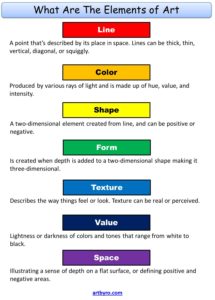
Elements of Art Definition
Allow'southward starting time past looking at the actual definition of the elements of fine art. Wikipedia describes them every bit the, "stylistic features that are included within an art piece to help the creative person communicate".
This specific definition is very academic and describes the higher level learning of art. Most likely for the purpose of becoming a professional artist. Although y'all may not be striving to exist a professional artist, or to even "communicate" through your artwork, you will still do good profoundly by agreement the elements of art.
Starting time Your Art Journeying Today
What Are The 7 Elements of Fine art
- Line
- Shape
- Color
- Value
- Texture
- Form
- Infinite
By using these elements, the creative person can create a more powerful piece of work of fine art. We are able to create works that conveys meaning and emotion. Without the use of the elements of art, a work of art will be boring and unorganized. It is impossible to create a work of fine art without using at least one of these elements.
Knowing the elements of art, and understanding how they are used, volition help you understand and clarify existing works of art. Going to the art museum will be more rewarding and looking at famous works of art will make more sense.
* Some of the links in this post may be affiliate links. This ways I receive modest commissions for purchases made through these links at no extra cost to you.
If you lot're education younger students about the elements of art, How to Teach Art to Children has several good lessons ideas in information technology.
Elements of Art – Line
Line is the most used chemical element of fine art and is the foundation of all drawings. A line may exist diagonal, vertical, horizontal, thin or thick. Likewise, lines can exist parallel, curved, cleaved, direct or zig-zagged.
A line isn't only a line. It can exist used in your artwork to evidence movement or convey emotion. You lot tin apply line for shading or to add together texture. Nosotros too employ line to move the viewer'due south eye through a work of art. In that location are so many ways we utilise line in our artwork, I tin't possibly think of them all. I know I've missed at least a few.
An entire work of fine art tin can be created with line alone. Below are a couple of Zentangles that I fabricated with only the use of line. Zentangles are a fun and relaxing form of art, hence the "Zen" in Zentangle.
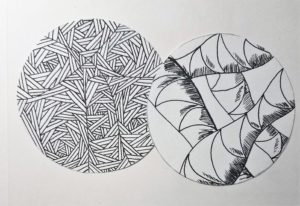
If you've never explored the fine art of Zentangle, do yourself a favor and look into information technology. You won't regret it. Especially if you're intimidated by creating art.
Yous tin get started by taking a look at, Zentangle Primer Pack Vol. 1 | Review. I highly recommend this pack equally a good starting bespeak.
Elements of Art – Shape
To be a shape, you have to have a line that connects at the beginning and at the end. The lines that create a shape can exist straight or tin exist curved. A shape tin exist positive or negative. It can be realistic or abstruse.
Shape tin be decorative similar a paisley, or symbolic like a cross. It can be organic, such every bit the shapes nosotros run across in nature that are soft and fluid. Or they can be geometric, which tend to exist abrupt and rigid.
In art, there are many different types and uses for shape. We tin even use shape as a foundation for more advanced drawings like we discuss in How to Utilize Shapes to Draw.
Color
Color is seen when light is reflected dorsum to your eye from an object. There are iii properties of color. They are hue, intensity, and value.
- Hue – the name given to the color (ruddy, blue, yellow, green, etc.)
- Intensity – the amount of saturation a color has
- Value – how light or night a colour is. This refers to tint (adding white) and shade (calculation black)
We tin can use color to show moods and emotions, such equally Picasso'due south blueish period when he was in a deep low. In his paintings this sadness was conveyed through the use of the color blue.
With the use of color, we tin show harmony in our artwork. Or mayhap you want to use it to bear witness a lack of harmony. We often use color to show contrast so we tin can make dissimilar areas of a work stand up out against each other.
Nosotros categorize colors in many different ways. Colors tin be primary, secondary, or tertiary. There are three master colors from which all other colors are made. The three primary colors are red, blue, and yellow. Secondary and 3rd colors are created through the mixing of the 3 primary colors.
There are also various means to group colors. Some colors are considered warm (yellow, orange, and reddish). And some colors are considered cool (blue, green, and purple). Colors can also be free or analogous. A color wheel is used to show this relationship between colors.
You can learn how to make your own colour wheel here, How to Make a Colour Wheel for Beginners.
Elements of Art – Value
Value is how we use light and night in our artwork. It can be shading from a pencil, or by mixing white or black to a color.
Value is used to create form, when creating the illusion of a third dimension in a ii-dimensional drawing. We also use value to show contrast by using lights and darks adjacent to each other in our art. With the proper use of value, we tin can also make our drawings wait more interesting and realistic. Nosotros use value in art to show depth and altitude. Value scales are what we employ to evidence the range of tones from white to black for a given medium.
Line can besides be used to bear witness value through the use of hatching and cross-hatching. Or we can employ dots in the form of stippling to show value by increasing or reducing the amount of dots we are using and how much infinite is between them.
The drawings below are similar to each other in that they are both checkerboard blazon designs. Yet, one is much darker than the other. I used value to evidence contrast between the two drawings.
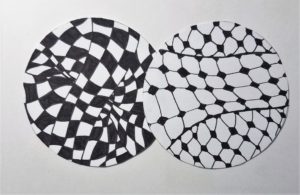
For a lesson on adding value with shading, check out How to Draw a Ribbon Name. Or, How to Draw a Value Scale.
Texture
Texture refers to the way an object looks or feels. When creating art, we are working with perceived texture, not actual texture (unless working with a three-dimensional object such as clay). When creating a drawing, or painting, you may want information technology to wait rough or shine.
There are many techniques we can use to create the illusion of texture in our artwork. Several painters take establish ways to incorporate actual texture in in that location works of art as well. Anselm Kiefer used straw and ashes, among other things, in many of his paintings. While fine art museums prohibit the touching of artwork, the textures are visually perceived.
Elements of Art – Class
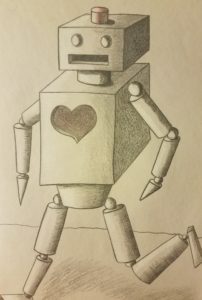
When a shape is made three-dimensional, it becomes a grade. Such as a sculpture. Also, it could be perceived in a two-dimensional work of art using shading and perspective. Spheres, cones, cubes, cylinders, and pyramids are all forms. When looking at a two-dimensional shape, you can simply run across i side and information technology appears flat. While a three-dimensional class has the appearance of taking up space and you can meet multiple sides.
- How to Draw a 3D Cube in half dozen Like shooting fish in a barrel Steps
- How to Draw a Cylinder in 3 Elementary Steps
Creating a drawing using one-point or two-betoken perspective is an example of the apply of form on a 2-dimensional surface. These are the techniques used to requite the illusion of space in a 2-dimensional world.
Form is also the actual 3-dimensional works of art made with clay, metal, wood, and architecture. Virtually people don't fifty-fifty realize that architecture is a grade of art. Frank Lloyd Wright has designed over 1,000 structures that are absolutely amazing works of art.
Nosotros are fortunate enough in the Toledo surface area to have a Frank Gehry pattern next to the Art Museum which houses the University of Toledo art classes. This is a beautiful building that is interesting only to look at, with information technology's fractured limerick and various levels.
For an art lesson of grade, check out How to Draw Robots Using Forms.
Space
The utilise of infinite can brand a flat paradigm look like it has form. This can be washed through the use of perspective, size, or overlapping. When talking about the foreground, middle ground, and groundwork, we are referring to space. Space is how nosotros evidence depth or altitude.
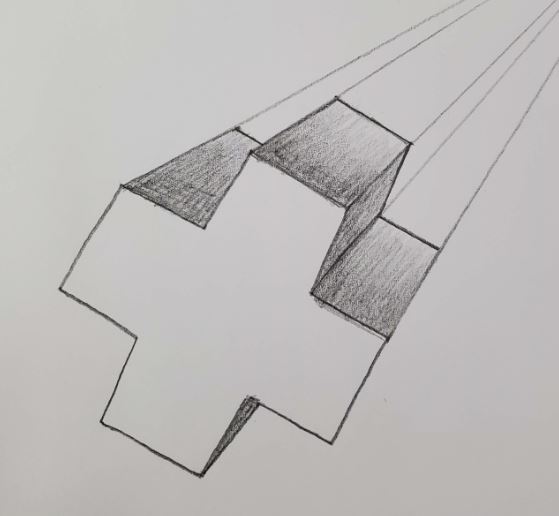
Here are some piece of cake beginner fine art tutorials on using i point perspective in art.
- How to Draw 3D Shapes
- Beginners Guide to Ane Signal Perspective
Space can exist positive, which is the area that is filled with content. Or infinite can be negative, which is the area effectually and betwixt the content.
How to Teach Art to Children, Grades i-6 is a good book when trying to teach the elements of art to younger students.
The 7 Elements of Art
Now that you lot are familiar with the 7 elements of art and how to use them, what will y'all be creating next?
Go Your Gratuitous Elements of Art Handout
More than Elements of Art Posts
- Robots with Forms
- Color Theory for Artists
- Creating a Value Scale
- 3D Cubes
- Drawing Cylinders

Roshanda is an art teaching blogger who is on a mission to charabanc and encourage as many aspiring artists equally possible through the use of her blog. Learn more than well-nigh her on the About Me page and connect with her on Facebook, Twitter, and Instagram.
0 Response to "A Drawing With All the Elements of Art All in It"
Post a Comment